Find and Color for Kids: Search and Look Fun
Maybe your child loves coloring but finishes a typical page in five minutes. Or you want an activity that holds attention longer than a flashy app. The Find and Color for Kids, Search and Look book solves both needs at once. It combines the calm focus of coloring with the thrill of a visual treasure hunt. Instead of simply filling blank spaces, children first have to find hidden shapes, tiny objects, and pattern details within larger scenes. This simple twist turns a coloring book into a mini adventure that strengthens key developmental skills.
What makes this digital version stand out is the flexibility it offers. You receive a ready-to-print collection of 100 pages packed with animals, landscapes, everyday objects, and playful landscapes. Every illustration has been designed so that the “searching” step never feels like an afterthought. The hidden details are woven naturally into the artwork, encouraging a child’s eyes to slow down and really look. Once they spot a hidden fish behind the coral or a tiny acorn tucked under a leaf, they get to pick up a crayon and bring it to life with color. The back-and-forth between finding and coloring keeps engagement high without relying on screens.
What Makes a Search-and-Color Book Different
A standard coloring book asks for one action: apply color to an outlined area. Find and Color for Kids, Search and Look adds a preliminary challenge. Every page includes objects deliberately camouflaged in the main picture—maybe a group of stars peeking through tree branches or a small cat hiding among rooftop chimneys. The child’s first task is to scan the illustration from left to right, top to bottom, identifying all the hidden elements. This process naturally builds visual discrimination, the brain’s ability to notice subtle differences in shape, size, and orientation.
After the search phase, coloring becomes more meaningful. Kids are no longer just staying inside the lines; they are completing a scene they have already studied closely. That sense of ownership often leads to more careful color choices and a longer period of focused work. Many parents report that their children will spend thirty minutes or more on a single page, revisiting it over several days to add new details or colors. Because the difficulty can vary—some pages have only a few obvious hidden items, while others hide up to a dozen tiny objects—a four-year-old and an eight-year-old can both enjoy the same book at different levels.
Building Skills That Go Beyond the Page
When a child sits down with a find-and-color activity, far more than creativity is at work. Visual perception skills are the foundation of reading, writing, and even math later on. Scanning for hidden pictures exercises the same eye-tracking muscles needed for following a line of text. Recognizing a small rotated shape among many similar ones directly supports letter recognition and mirror-image differentiation. This is why occupational therapists and early childhood educators often recommend search-and-find coloring pages as a playful way to support pre-literacy.
Fine motor development gets a boost, too. Holding a crayon to carefully fill in a discovered butterfly or a tiny mushroom tucked behind a rock builds the hand strength and coordination required for handwriting. Because the hidden items vary in size, children naturally practice both broad strokes and precise control. Color recognition also deepens as kids decide how to shade each element—should the hidden owl be brown like the tree bark or stand out in bright blue? These small choices reinforce naming colors, comparing shades, and understanding contrast without turning it into a drill. The Find and Color for Kids, Search and Look book weaves learning into an activity that feels like pure play.
Who Can Put This Digital Book to Good Use
The audience for this printable collection is wider than you might expect. Parents looking for quiet time alternatives or independent play stations will appreciate having 100 pages ready on demand. Instead of buying multiple disposable coloring books, you print only the pages your child is interested in today. If a sheet gets torn or covered in stickers, you simply print another copy. This repeatability is a lifesaver for road trips, waiting rooms, or rainy afternoons when boredom strikes hard.
Teachers and homeschool educators can integrate the pages into learning centers, morning work routines, or thematic units. A farm animal page with hidden tools can accompany a lesson about where food comes from. An ocean scene with hidden shells and starfish pairs beautifully with a marine biology week. The search-and-color format doubles as a calm-down corner resource because the focused scanning helps children self-regulate when they feel overwhelmed. Speech therapists often use such pages to encourage descriptive language, asking questions like, “Can you tell me where you found the little fish before you color it?”
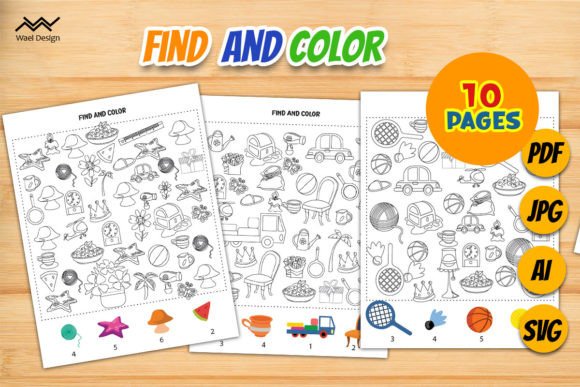
Creative small business owners and crafters also find real value in the included digital files. The download contains not just a print-ready PDF but also 10 high-resolution JPGs, 10 scalable SVG files, and an editable AI Adobe Illustrator template. If you run a children’s activity subscription box, a printable shop, or a daycare resource library, having templates you can adapt (with proper licensing) saves hours of design work. Even for personal use, the SVG versions allow you to resize the artwork for smaller coloring cards, puzzle cutouts, or digital coloring on a tablet.
What You Actually Get in the Download
When you purchase Find and Color for Kids, Search and Look, you receive a meticulously organized digital package. The core of the collection is a 100-page PDF, already sized to American letter dimensions—8.5 by 11 inches (21.59 x 27.94 cm). Every page is set at 300 DPI, which means crisp lines and smooth curves even when you print on a high-quality inkjet or laser printer. No pixelation, no muddy edges, just clean outlines that are a pleasure to color.
- AI Adobe Illustrator template – one master file that lets you adjust colors, add text, or modify line art if you have the software and need a custom version.
- Print-ready PDF – the quickest route to printing: open, hit print, and you’re done. All pages are organized for single-sided printing so markers won’t bleed through to another design.
- 10 JPG files – individual high-resolution images that import easily into word processors, slideshow apps, or framing software for digital display.
- 10 SVG files – fully scalable vector graphics you can enlarge for a giant wall poster, shrink for mini coloring cards, or use with cutting machines for a hybrid paper craft project.
Because every format is included, you are never locked into a single way of using the book. One day you might print a few pages for a preschooler; the next week you could load an SVG into your design software to create a custom birthday party activity sheet. This flexibility is a major reason educators and creative professionals keep such versatile resources in their digital toolkits.
Printing and Using the Pages Successfully
Getting the best result from any printable activity book depends on a few practical choices. First, consider paper weight. Standard 20 lb copy paper works, but for coloring with markers or paint sticks, a heavier paper like 24 lb or even a light cardstock (65 lb) will prevent buckling and bleed-through. If your child prefers crayons or colored pencils, regular paper does just fine. For a classroom binder of reusable activities, you can print on cardstock, slip each page into a plastic sheet protector, and let kids use dry-erase markers. That way the same page can be searched and colored again and again.
Printing settings matter. Always choose “Actual Size” or set scaling to 100% so the hidden details keep their original proportions. If your printer offers a borderless option, using it will give children the full 8.5×11 inch canvas, though many printers require a small margin. Test one page first and adjust as needed. For best color saturation, turn off any “ink-saving” or “draft mode” functions unless you are just taking a quick look. The 300 DPI files reward a high-quality print setting with exceptionally clean lines.
Storage is another consideration. With 100 pages, you may not want to print everything at once. A simple three-ring binder with tab dividers lets you organize pages by theme or difficulty. You can also create a portable folder with a dozen seasonal pages to rotate during the year. Because the digital files never expire, you can print a fresh set whenever the old ones are fully colored or worn out.
Creative Extensions to Deepen the Learning
Once a child has found and colored a scene, the page can live on in new ways. Cut out the completed illustration, attach it to a cardboard tube, and you have a storytelling puppet theater backdrop. Turn a colored animal page into a simple puzzle by cutting along some of the natural outlines. Ask children to make up a short story about what happens next in the picture they colored—this bridges visual art with oral language development. The large variety of scenes in the Find and Color for Kids, Search and Look collection, from cityscapes to underwater worlds, gives you endless raw material for extended play.
For group settings, you can introduce a cooperative twist. Print two copies of the same page, give one to each child, and have them race to find all the hidden items while coloring together. Or slow it down by turning it into a “color by instruction” listening game: “Find the frog and color it green, then find the smaller bug and color it orange.” Such variations keep the activity fresh across multiple uses, which is especially helpful in classrooms and sibling settings where repeat engagement matters.
Things to Keep in Mind Before You Start
While the 100-page collection provides tremendous variety, it helps to know that not every child will connect instantly with the search-and-color format. Some very young toddlers may need an adult to guide their eyes and point out initial hidden objects until they catch on. For them, starting with the simpler pages—those with larger and fewer hidden items—builds confidence. As they grow, you can gradually introduce the more intricate scenes. The book is designed to support multiple skill levels, so mixing easy and challenging pages keeps frustration at bay.
It’s also important to remember that the product is a digital download. You will need a device capable of opening PDFs, JPGs, SVGs, and optionally AI files, plus access to a printer. The page dimensions are locked to American letter size, which works seamlessly with printers sold in North America and many international models that support that size. If you primarily use A4 paper, you may need to scale the print slightly or trim the edges, though the difference is minor. The AI template and SVGs give you the power to adjust sizes accurately if you have the right design tools.
Regarding commercial use, always check the seller’s licensing terms. Many educators and crafters purchase such resources to create bound activity books for their students or to incorporate a page into a larger event kit. The presence of an editable AI template suggests a creator-friendly approach, but clarifying what you can and cannot do with the files will protect your project. The shop offering Find and Color for Kids, Search and Look often provides additional wonderful products, so following the store is a smart way to discover similar high-resolution, print-ready resources in the future.
In a world where children’s activities can feel either too passive or too screen-dependent, a well-designed find-and-color book strikes a rare balance. It asks for active looking, rewards patience, and hands the creative reins entirely to the child. Whether you are a parent hoping to foster a quiet afternoon hobby, a teacher building a versatile classroom resource, or a creator seeking a quality digital template, the combination of a large page count, multiple file formats, and thoughtful design makes Find and Color for Kids, Search and Look a valuable addition to your collection. You don’t just get a coloring book—you get a flexible, printable system that grows alongside the children who use it.