Adults Hard Triangle Mazes Puzzle Vol-33: A Practical Resource for Cognitive Training and Focused Problem-Solving
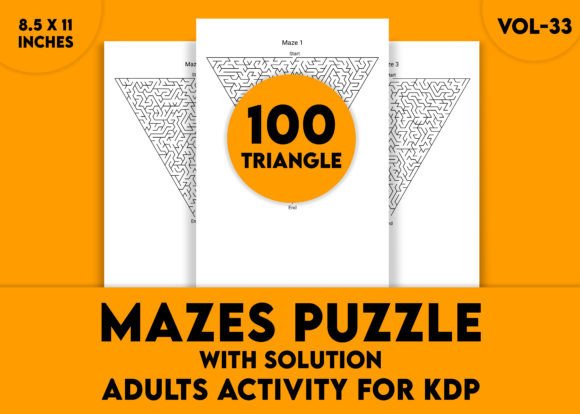
When you pick up Adults Hard Triangle Mazes Puzzle Vol-33, you're not just grabbing a collection of puzzles. You're accessing a structured, deliberately difficult set of 100 triangle-based mazes printed in a clean, large-format 8.5x11 inch layout. The triangular grid changes the way your brain maps routes, anticipates dead ends, and recovers from wrong turns. For adults who spend their days making decisions, managing projects, or producing creative work, this shift in spatial reasoning patterns offers something that standard rectangular mazes simply don't.
What distinguishes this volume is its practical design. Each maze occupies a full page, which eliminates visual clutter and gives you enough room to trace paths without squinting or second-guessing line intersections. The solutions are grouped four per page at the back, so you can check your work quickly without accidentally glimpsing answers to puzzles you haven't attempted yet. The PDF is editable and print-ready, meaning you can work on a tablet with a stylus or print individual sheets as needed. These aren't novelty features; they're usability decisions that affect how consistently you'll actually use the resource.
Where Hard Triangle Mazes Fit into Adult Cognitive Work
Most discussions about puzzles for adults default to vague claims about brain training. But the real value of something like Adults Hard Triangle Mazes Puzzle Vol-33 becomes clearer when you look at it through the lens of deliberate cognitive recovery and pattern-interruption. If your work involves prolonged analytical focus—coding, writing, financial modeling, design iteration—your brain settles into well-worn neural pathways. That efficiency is useful until it becomes rigidity. Introducing a spatial challenge that operates on completely different rules than your daily work forces your brain to switch modes, which can reduce mental fatigue more effectively than passive rest.
Triangle mazes specifically add a layer of complexity because the three-sided cell structure creates junction types that don't appear in square grids. Paths intersect at angles that can look deceptively open or closed depending on which direction you're approaching from. You'll encounter multiple branches and loops that require you to hold several possible routes in working memory simultaneously, track which paths you've already eliminated, and recognize when you've circled back to a previously visited point. This taxes visual-spatial working memory and executive function in ways that directly complement—and contrast with—the verbal and numerical processing most knowledge workers rely on.
The Role of Structured Difficulty in Maintaining Engagement
Puzzle difficulty exists on a spectrum, and the "hard" designation here matters for retention. Puzzles that are too easy get abandoned because they're boring. Puzzles that are impossibly difficult get abandoned because they're frustrating. The sweet spot, which this volume targets, is the zone where completion feels earned but achievable. The inclusion of obstacles and barriers within the maze paths means you can't simply brute-force every route by process of elimination; some dead ends are visually obvious, while others only reveal themselves after several turns.
This design philosophy aligns with what we know about sustained voluntary engagement. When you sit down with one of these mazes, you're committing to a single-session problem that might take anywhere from five to twenty minutes depending on your spatial reasoning speed. The one-per-page format respects that commitment by giving each puzzle its own physical or digital space, reducing the temptation to flip ahead or skip around. For people who struggle with task-switching or attention fragmentation, this enforced single-focus session is a feature, not a limitation.
Integrating Maze Solving into Existing Routines and Workflows
How you use Adults Hard Triangle Mazes Puzzle Vol-33 depends on what gap you're trying to fill. For some, it functions as a morning warm-up—a 10-minute spatial exercise before diving into email and meetings. For others, it's an afternoon reset when focus starts to drift and the temptation to scroll social media kicks in. The physicality of maze-solving, whether on paper or with a stylus, engages motor planning alongside visual processing, creating a more complete cognitive shift than simply reading or watching something.
Here are several integration points that have emerged from how adults actually use resources like this:
- Pre-deep work transition: Spend 5-10 minutes on a maze to clear your head of residual thoughts from the previous task before starting focused work that requires fresh perspective.
- Meeting reset buffer: After a draining meeting, solving a maze can help you shift out of social processing mode and back into independent analytical thinking.
- Creative block disruptor: When you're stuck on a problem that needs lateral thinking, the non-verbal, spatial nature of triangle mazes can activate different neural networks and sometimes unlock a new angle on the original problem.
- End-of-day wind-down: Unlike screen-based activities that can interfere with sleep preparation, printing a maze and solving it on paper provides a satisfying closure ritual without blue light exposure.
- Travel or waiting time: The editable PDF format means you can keep the file on a tablet and work through a maze during flights, commutes, or any pocket of downtime without needing connectivity.
Print, Digital, and Hybrid Approaches
The large 8.5x11 inch size is standard enough to print on any home or office printer, but spacious enough to work on comfortably. If you're printing, standard copy paper works, but heavier stock reduces bleed-through if you're using markers or pens. Some users prefer to print a batch of 10-15 mazes at once and keep them in a folder or clipboard, creating a grab-and-go set for the week. The solutions being grouped four per page means you can decide whether to keep the answer pages separate, check as you go, or only reference them after attempting all mazes in a batch.
If you're using the file digitally, the editable PDF format allows you to draw directly on the maze layer in apps like GoodNotes, Notability, or any PDF annotation tool that supports stylus input. This preserves the reusability of the file—you can always print a fresh copy or clear annotations. For teams or groups, a single purchase provides a resource that can be shared across devices or printed multiple times, making it practical for office break rooms, educational settings, or family use.
Triangle Mazes as a Tool for Quality Control in Personal Systems
There's a less obvious application for a resource like Adults Hard Triangle Mazes Puzzle Vol-33, and it has to do with self-assessment. Because triangle mazes present a consistent difficulty format, you can use them to track your own cognitive state over time. How quickly do you solve a maze on Monday morning versus Friday afternoon? After a full night's sleep versus after a poor one? Before coffee and after coffee? These patterns are personally informative even if you're not formally measuring anything.
Marketers, entrepreneurs, and anyone whose performance depends on sustained cognitive output can benefit from having a low-stakes benchmark activity. If you notice that your maze completion time or error rate jumps significantly under certain conditions, that's data you can apply to scheduling your most demanding work. The consistency of the triangle format across all 100 puzzles means the difficulty range stays within a predictable band, so you're comparing like with like more reliably than if you were switching between different puzzle types.
Compatibility with Broader Wellness and Productivity Systems
Puzzle solving doesn't exist in isolation. It interacts with whatever else you're doing to maintain cognitive health and manage your workload. If you already practice meditation, journaling, or regular exercise, adding maze sessions complements those practices by engaging a different mode of focused attention. If you use productivity frameworks like time-blocking or the Pomodoro method, a single maze fits neatly into a standard 25-minute Pomodoro session with time to spare, or you can use it during longer breaks between 90-minute deep work blocks.
The key is consistency and intentionality. A resource like this works best when you've identified a specific slot in your routine where it adds value, rather than treating it as an occasional diversion. The volume provides enough puzzles—100 in total—to support daily use for over three months, or less frequent use stretched across a longer period. By the time you've worked through all 100, the accumulated spatial reasoning practice will have built patterns that transfer subtly to other areas where route-finding, contingency planning, and backtrack recovery are relevant, even if those areas are entirely conceptual rather than physical.
Organizational and Implementation Considerations
Before you start working through the mazes, take a few minutes to set up a system that keeps the experience smooth. If you're printing, number your sheets or keep them in order so you can match them to the solution pages later. Consider whether you want to date your completed mazes—some people find it satisfying to track progress, others prefer to keep the activity judgment-free. If you're working digitally, create a dedicated folder for the PDF and any exported completed versions so your maze work doesn't get lost among other documents.
One practical consideration: the one triangle per page format means you're committing to a single puzzle at a time visually. This is actually a deliberate design choice that prevents the overwhelm that can come from seeing dozens of unsolved puzzles on a single spread. It also means you can share individual pages with colleagues, family members, or clients without handing over the entire collection. If you're in an educational or coaching context, this makes the resource modular and distributable in a controlled way.
Long-Term Value and Reusability
Because the PDF is editable, you effectively have an unlimited number of attempts. You can print the same maze multiple times if you want to improve your time or try different solving strategies, such as starting from the end and working backward or systematically eliminating branches from the outside in. The solutions being grouped four per page also means you can choose to hide them from yourself entirely, creating a genuine test of skill without the temptation of immediate answers.
For small business owners, coaches, or educators who work with adults on cognitive skills, focus training, or stress management, a resource like this can be integrated into workshops, one-on-one sessions, or self-directed assignments. The professional format—clean lines, clear printing, organized solutions—means it presents well when shared and doesn't require explanation beyond the basic premise. The triangle format specifically adds novelty that distinguishes it from the more common square or circular maze types that people may already be bored with.
Why the Format Matters as Much as the Content
It's worth pausing on the format decisions because they directly affect usability in ways that aren't immediately obvious from a product description. The 8.5x11 inch size isn't just "large"—it's the standard sheet size for North American printers, binders, and folders. That means you can integrate printed mazes into existing organizational systems without trimming, folding, or using special storage. The editable PDF format means you're not locked into a proprietary app or platform; PDF annotation is universally supported across devices and operating systems.
The 4 solutions per page layout is efficient without being crowded. Each solution is large enough to trace and compare against your own attempt, which matters when you're trying to understand where you went wrong rather than just confirming whether you finished. For mazes with multiple viable routes, the published solution shows one successful path, but the triangle structure sometimes allows for alternate solutions, which adds a layer of post-completion analysis if you're interested in optimization rather than just completion.
Moving from Casual Use to Deliberate Practice
Anyone can solve a maze. But using Adults Hard Triangle Mazes Puzzle Vol-33 as part of a deliberate cognitive practice means paying attention to your process, not just your outcomes. Notice whether you tend to favor certain directions when starting. Observe how you react when you hit a barrier—do you backtrack immediately, or do you push forward hoping for a breakthrough? These micro-decisions mirror problem-solving patterns that show up in professional contexts, from debugging code to navigating organizational politics to iterating on a design.
The repeated exposure to a consistent puzzle format over 100 variations builds pattern recognition gradually. By the time you're 30 or 40 mazes in, you'll likely notice that you're scanning more efficiently, holding more alternative routes in mind simultaneously, and recovering from dead ends with less frustration. That progression is the real payoff, and it's why a single large collection like this offers more developmental value than scattered, one-off puzzles from different sources with inconsistent difficulty and formatting.
Whether you integrate it into a morning routine, use it as a focus reset, or simply keep it available for moments when you need a satisfying mental challenge that doesn't involve a screen, the resource delivers what it promises: hard triangle mazes designed for adults who appreciate practical, well-organized tools that fit into real life.