Abstract Notes: A Versatile Interior for Journals, Brainstorming, and Creative Publishing
When you first encounter the Abstract Notes template, it’s easy to see it as just another notebook interior. But spend a little time with the files, and you begin to understand why people keep coming back to designs that blend structure with a touch of artistic freedom. This isn’t a rigid planner where every line dictates what you should write; it’s an open canvas with subtle abstract elements that quietly guide your thoughts without boxing them in. For self-publishers, creators, and anyone who wants a notebook that feels more like a thinking space than a form to fill out, Abstract Notes fills a gap that plain lined pages often miss.
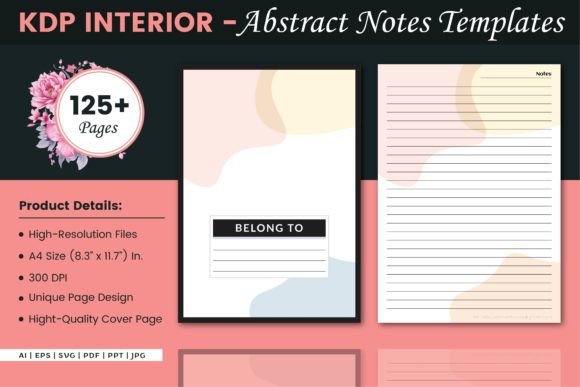
The download package includes everything you need to either upload directly to Amazon KDP or customize for your own brand. You get 125 pages formatted exactly for an A4 trim size (8.3×11.7 inches) with no bleed, a ready-to-use PDF, and vector source files in AI, EPS, and SVG formats. There’s even a PPT version and high-resolution JPGs if you want to mix and match pages or use them digitally. On the surface, that’s a solid checklist. What matters more is how these creative assets actually behave in the hands of different users—from a first-time KDP author to a small business owner who wants a branded notebook for a workshop.
Who Finds Abstract Notes Most Useful
This interior attracts a surprisingly wide range of people, and not always the ones you’d expect. Yes, it’s built with KDP in mind, but the real value goes deeper than just uploading and listing. A freelance coach might use the template to compile session notes that don’t feel clinical. An artist might print a few pages to sketch alongside abstract shapes that spark new ideas. A teacher could adapt the design for a student journal that encourages reflective writing without looking like a school handout. Because the file types are editable, every one of these users can make the pages their own without starting from scratch.
Small business owners often find dual uses. They might sell a customized version on Amazon while also printing a batch for in-person events. The abstract elements—soft geometric forms, layered textures, or fluid lines depending on the variant—add a professional yet creative polish that plain notebooks simply can’t match. When you hand someone a journal that looks intentional, they treat the content inside with more respect. That subtle shift in perception matters whether you’re giving it away or selling it for profit.
How to Turn Abstract Notes into a Real Product
If you’ve ever published on KDP, you know the frustration of formatting. Margins shift, text cuts off, or the file gets rejected for bleed settings you thought you understood. Abstract Notes comes with a PDF interior already sized perfectly for A4 without bleed, meaning you can upload it directly without fiddling with margins. The 125-page count strikes a nice balance—enough thickness to feel substantial, not so heavy that printing costs eat your margin. For many creators, that ready-to-upload file alone saves two or three frustrating evenings of trial and error.
But the editable files open a different door entirely. Using Illustrator or even PowerPoint, you can change the abstract motifs, add a logo, insert page numbers, or layer prompts into the design. A podcaster, for example, might add gentle question prompts for listeners to use as a companion journal. The source vectors let you resize or recolor abstract elements so the final product feels fully yours. This flexibility matters because audiences can tell when a notebook is just a generic download with a cover slapped on versus one designed with care. They’re more likely to leave reviews, buy again, or recommend it to others when the inside matches the promise of the cover.
Using Abstract Notes Beyond Amazon KDP
The real power of this template shows up in places a standard KDP interior never goes. Because the file pack includes EPS and SVG formats, graphic designers drop the pages into branding projects—think lookbooks, portfolio pitch decks, or client welcome packets. The abstract background adds texture without dominating, so text remains readable while the overall design feels less corporate. An online course creator might bundle printable worksheets made from the PPT version, giving students a visually calming space to process lessons. Even in a purely digital context, the JPGs can become backgrounds for tablet note-taking apps, providing a consistent aesthetic across different modules.
Educators and workshop facilitators often need something that doesn’t look like a textbook. Abstract Notes provides a mature, understated backdrop for note-taking during retreats, creative writing sessions, or design sprints. Because the interior has 125 pages, you can print only the sheets you need—say, 20 for a single event—and keep the rest for another purpose. There’s no waste, and the cost per print remains low. One trainer I know prints a handful of pages for each participant and adds a personal message on the last sheet using the editable file, turning a generic notebook into a memorable takeaway.
What Makes This Interior Different from Basic Notebooks
Basic notebooks serve a function; Abstract Notes serves a feeling. The abstract design isn’t random chaos. It uses a visual rhythm that helps the eye rest between thoughts. When you’re brainstorming or journaling, a blank white page can feel intimidating; a heavily lined page can feel restrictive. The subtle abstract patterns give just enough structure to start writing without dictating where or how. For people with ADHD, creative professionals who work visually, or anyone who struggles with perfectionism in a pristine Moleskine, this approach lowers the barrier to getting words down.
From a production standpoint, the format choices matter more than they seem. A4 sizing might sound European, but it prints beautifully on standard US letter paper with just a small adjustment—and for international markets, it’s the standard. No-bleed design means you don’t lose parts of the abstract pattern near the edges, even if your printer clips slightly. The 125-page count also works well for coil binding, perfect binding, or just hole-punching for a binder. These practical details help users avoid the “it looked great on screen” disappointment that sometimes comes with interiors designed purely for digital display.
What to Keep in Mind Before Downloading
No template removes the need for basic preparation. You’ll still want to check Amazon’s current guidelines for notebooks; KDP rules can change, and while this interior is designed to comply, it’s smart to review. If you plan to edit heavily, some comfort with Illustrator or similar vector software helps, though the PPT file offers a more beginner-friendly path. The abstract style, while versatile, may not suit every brand—consider whether the visual tone aligns with your audience. A hardcore corporate planner crowd might prefer cleaner lines, whereas a wellness or creative community will likely embrace it.
Also, remember that commercial use comes with responsibility. The source files are editable, so you can and should make them your own rather than reselling the raw template as-is. Slight modifications—a color shift, repositioned elements, or an added header—go a long way toward originality. The extra cover page included in the download is a helpful starting point, but you’ll want to create a cover that complements the interior and speaks directly to your niche. A matching design feels cohesive, and customers notice that attention to detail.
Creative Ways to Customize the Pages
Even small tweaks can unlock entirely new products. One user took the Abstract Notes interior and added a weekly reflection section at the bottom of every fifth page, turning it into a guided journal for new parents. Another removed some abstract elements from half the pages to create a split-design book with plain reverse sides for sketches. Because the files are vector, you can scale elements, change opacity, or even combine them with your own hand-drawn scans to produce a truly hybrid aesthetic.
If you’re less confident with design tools, the PPT version is surprisingly capable. You can overlay text boxes with journal prompts, drop in a calendar grid, or add a subtle brand watermark. Export the edited slides as a PDF, and you have a print-ready file. This approach works especially well for coaches and therapists who want a client notebook that reinforces their methodology without hiring a designer. The time saved by starting with a proven layout instead of building margins and gutters from zero is significant—often weeks of tinkering condensed into an afternoon.
For those who sell printables on Etsy or other marketplaces, the SVG and EPS files integrate directly into Canva or other online editors, allowing further customization for digital planner enthusiasts. The 125 pages provide plenty of material to repackage as a monthly journal, a travel diary, or a creative brief workbook. Because abstract art never really goes out of style, you avoid the seasonal design trap that plague trend-driven interiors. What you’re really buying isn’t just a single notebook; it’s a foundation that can be reconfigured dozens of times over, paying for itself again and again.
The Practical Side of a Well-Structured Design
It’s worth discussing what “no bleed” actually means for someone who hasn’t published before. Bleed is the extra area that gets trimmed off after printing, and interior pages with bleed require precise margins to avoid white strips. Without bleed, the Abstract Notes interior prints edge-to-intentional-edge, and you won’t need to adjust your trim size. That simplifies the upload process considerably and reduces the chance of rejection. For a first-time publisher, that one feature can be the difference between launching a product this week and abandoning it in frustration.
The package also includes a JPG version of each page, which opens up possibilities for digital use beyond printing. You can import individual pages into GoodNotes, Notability, or OneNote for a consistent look across devices. Marketers might use a single page as a newsletter background or a social media template. The abstract design is neutral enough to serve many purposes but distinctive enough to be recognizable. It walks a line that few interiors manage well.
Ultimately, Abstract Notes works because it respects both creativity and practicality. It gives you enough design to feel intentional, enough flexibility to feel personal, and enough structure to feel reliable. For someone tired of sterile checklists, for the creator who wants their notebooks to have personality without chaos, and for the self-publisher who values time over theory, this kind of interior answers a quiet need: a place where thinking looks as good as it feels.